
होमKabaddiKabaddi: From the Mud Akhada to Prime Time — India's Most Successful Non-Cricket Experiment
Kabaddi: From the Mud Akhada to Prime Time — India's Most Successful Non-Cricket Experiment
कबड्डी एक सात-खिलाड़ी वाला दक्षिण एशियाई टीम-संपर्क खेल है, जो 13×10 मीटर कोर्ट पर खेला जाता है। एक समय में एक रेडर विपक्षी हिस्से में जाकर 30 सेकंड के भीतर लौटता है और लगातार 'कबड्डी' का उच्चारण (कैंट) करना होता है; कैंट टूटने पर रेड रद्द। स्कोरिंग: टच 1 अंक, बोनस लाइन 1 अंक (जब रक्षा में 6+ खिलाड़ी हों), ऑल आउट 2 अंक और विरोधी टीम पूरी तरह पुनर्जीवित, सुपर टैकल 2 अंक (रक्षा में 3 या कम खिलाड़ी होने पर), सुपर रेड 3+ अंक। दो लगातार खाली रेड के बाद तीसरी रेड डू-ऑर-डाई होती है — असफल होने पर रेडर खुद बाहर। कबड्डी की दो शैलियाँ हैं: स्टैंडर्ड स्टाइल (PKL और एशियाई खेल) और सर्कल स्टाइल (मुख्यतः ग्रामीण पंजाब)। अंतरराष्ट्रीय स्तर पर भारत प्रभुत्वशाली है और ईरान स्थापित चुनौती — पुरुषों का 2018 एशियाई खेल स्वर्ण ईरान के नाम रहा। भारत में प्रो कबड्डी लीग (PKL) सबसे सफल गैर-क्रिकेट पेशेवर लीग है, जिसका संचालन मशाल स्पोर्ट्स करता है और मीडिया राइट्स ऐतिहासिक रूप से स्टार/डिज़्नी स्टार के पास रहे हैं। गवर्नेंस सीढ़ी: IKF → AKFI → मशाल स्पोर्ट्स। महिला कबड्डी को एशियाई खेलों में दर्जा है, लेकिन कोई पेशेवर लीग नहीं। टोक्यो और पेरिस, दोनों ओलंपिक बिड असफल रहीं; मुख्य आपत्ति वैश्विक भागीदारी विस्तार और महिला खेल की स्थिति पर थी।
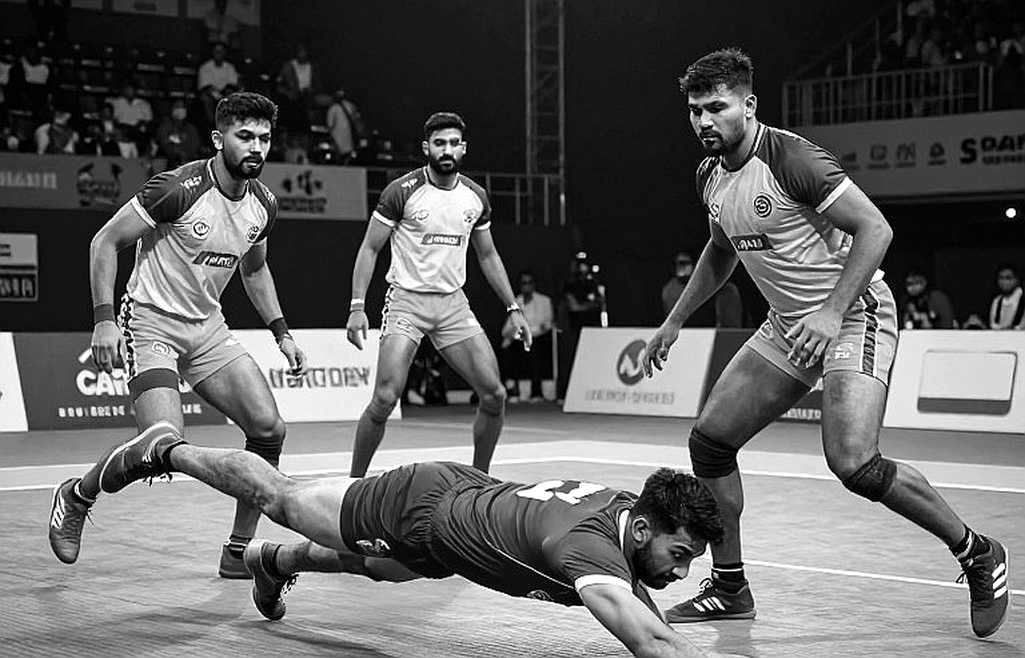
Understanding kabaddi begins with its court. A 13-metre by 10-metre mat, two teams of seven, and two twenty-minute halves — the basic structure is so plain that at first glance the sport looks like any other traditional field game. But the rules nested inside that plainness are what make kabaddi one of the fastest and most dramatic team contact sports in the world.
The centre of the game is the raid. One player at a time — the raider — steps into the opposition half and tries to return within thirty seconds. Throughout, he must keep chanting 'kabaddi-kabaddi', which is called the cant. This is no formality: the cant proves the raider is not holding his breath. If the chant breaks, the raid is void. On the other side, the defence's collective effort is the tackle — stopping the raider inside their own half and restraining him. Corner, cover and 'in' are the defensive positions that form any team's spine, and their coordination is the clearest indicator of how disciplined a defence really is.
The arithmetic of scoring is the game's real trick. Touching an opponent is worth one point; crossing the bonus line is worth one point — but only when the defending side has six or more players on the court. An all out earns two points and revives every dismissed player on the opposing side. This 'team-wipe reset' is kabaddi's most distinctive mechanism: a large lead can collapse in seconds. A super tackle — completed when the defence is down to three or fewer players — is worth two points, and scoring three or more points in a single raid is a super raid.
The most pressure-laden rule of all is the do-or-die raid. After two consecutive empty raids, the third becomes mandatory-scoring; if it yields nothing, the raider himself is dismissed. This single rule governs the temperature of the entire match — teams cannot raid vaguely, they are forced to take risk. The bonus line rewards deep raiding, the all out keeps the door to a comeback open, and do-or-die sustains the pressure. Together these three produce kabaddi's signature tempo: fast scoring and repeatedly swinging momentum. That is precisely why the sport fits so neatly into short prime-time television windows.
One basic confusion needs clearing up here. Kabaddi has two distinct variants — Standard Style and Circle Style. Standard Style is what is played in Pro Kabaddi League and at the Asian Games; Circle Style belongs mainly to rural Punjab tournaments and differs in court geometry and scoring detail. Conflating the two is the most common error in cross-language coverage.
At international level the picture has broadly shifted from unipolar to bipolar. India has been historically dominant, but Iran has emerged as an established challenger — the men's 2026 Asian Games gold is the clearest proof of that. South Korea sits in the catch-up group on the strength of systematic training and PKL exposure. In Bangladesh kabaddi is the national sport with deep grassroots roots, yet its professional structure has lagged. Pakistan's strength lies in Circle Style, and nationalist sentiment weighs heaviest on its fixtures against India. Development in countries such as Nepal, Sri Lanka and Kenya is scattered but present.
Domestically the competitive structure is multi-polar. Haryana, Maharashtra, Punjab, Uttar Pradesh and Tamil Nadu are the core talent states, where the akhada tradition underpins grassroots supply. In the Pro Kabaddi League, dynastic franchises such as Patna Pirates sit alongside newer contenders, and the draft and auction mechanism serves as the formal instrument of competitive balance.
Commercially, PKL is widely regarded as India's most successful non-cricket professionalisation experiment. Revenue rests on media rights (historically concentrated with the Star/Disney Star network), title sponsorship, ticketing and licensing. City-based franchises are owned largely by Indian corporate groups and entertainment figures, and Mashal Sports operates the league.
The player auction is the sport's most transparent price-discovery mechanism. Base prices graded A, B, C and D, plus a separate overseas player pool, together determine the market value of any raider or defender. This is also where the game's biggest financial challenge is born: the premium paid for stars does not always match their output, and numbers built on one or two seasons often turn out to be small-sample errors.
Kabaddi's social strength lies in its rural roots. Most players come from poor farming families, and a government job — railway, police, army — is the single biggest incentive to stay in the sport. That is why a PKL contract is not merely money for a player but an entry point into social mobility. Alongside this runs another insight: urbanisation is gradually narrowing this rural talent pipeline.
Women's kabaddi is the most incomplete part of the whole picture. Women's kabaddi holds permanent status at the Asian Games, yet there is no corresponding professional league — PKL remains men-only even today. This imbalance makes plain the gap between the sport's claims and its actual structure.
The governance ladder rests on three levels: the International Kabaddi Federation internationally, the Amateur Kabaddi Federation of India domestically — whose history has been riddled with controversy — and Mashal Sports at league level. Federation turmoil can at any point become a question mark over suspended events or national team participation; monitoring this dimension is therefore essential.
The Olympic path remains closed. Kabaddi's bids for both Tokyo and Paris hosting did not succeed — the principal objections concerned the global spread of participation and the state of the women's game. This is not merely a question of prestige; Olympic recognition would simultaneously transform funding, grassroots programmes and the international calendar.
The list of risks is long. As a high-contact sport, the load of knee, ankle and shoulder injuries sits at the top. The game's second structural weakness is dependence on a single raider — many teams build their entire scoring architecture around one player, and if he is injured the strategy itself collapses. Beyond that, an auction premium bubble, dependence on a single broadcaster, and the decay of viewer novelty remain persistent threats.
At industry level, leagues in badminton, wrestling, volleyball and table tennis have tried to adopt the PKL template, with mixed results. Wrestlers and judoka moving towards kabaddi is an interesting cross-sport signal, and the kabaddi verticals of fantasy platforms such as Dream11 connect the sport to the digital economy.
The conclusion is simple. Kabaddi possesses three things most Indian sports do not — codified, television-friendly rules, a functioning professional league, and a clear ladder from village to national team. What it does not possess is equally clear: a professional platform for women, Olympic recognition, and scoring depth beyond a single star. Closing these three gaps is what will decide whether kabaddi's next decade moves past 'India's most successful non-cricket experiment' to earn the status of a truly global game.
संबंधित खिलाड़ी
अनुशंसित
Commonwealth Kabaddi Championship begins in Ahmedabad; India women face Malaysia, men take on England2026-11-11
The Ledger Had a Column for Day Jobs: Women's Kabaddi's Medals, Its Payroll, and the League That Never Started2026-10-25
Kabaddi Champions League Expansion: 10 Teams, a Rs 5 Crore Purse and a Regional Experiment Amidst PKL's Broadcast Crisis2026-11-04
Commonwealth Kabaddi Championship 2026: A 13-Nation Mat in Ahmedabad and the Question Nobody Answered2026-11-10
Kabaddi: From Village Mud to the Global Arena2026-11-02
Kabaddi Champions League Expansion: The Rs 5 Crore Purse and the Shadow of PKL2026-11-03
First Commonwealth Kabaddi Championship Begins in Ahmedabad, With CWG 2030 Inclusion in Sight2026-11-08
Surjeet Singh captain, Naveen Kumar deputy: the real Commonwealth Kabaddi Championship story is the squad list nobody published2026-10-23
अनुशंसित
Kabaddi: From the Soil to the Global Stage, India's Traditional Sport Now a Multi-Crore Industry2026-11-02
Kabaddi: From Mud to Mat, India's Fastest-Changing Sport2026-10-31
Commonwealth Kabaddi Championship 2026, Day 1: The Table Adds Up Perfectly, and the Biggest Story Is a Team That Has Not Played Yet2026-10-28
The Empty File of Kabaddi Injury Reporting: No Data, No Diagnosis2026-11-05
The Auction Headlines Count Big Bids; the Real Scorecard Is the Unsold Names2026-11-01
First Commonwealth Kabaddi Championship Begins in Ahmedabad, With CWG 2030 Inclusion in Sight2026-11-08
Commonwealth Kabaddi Championship 2026 in Ahmedabad from October 23: 13 Teams, Nine Days, and a Team List Left Blank2026-10-23
The Tackle Ledger: Corners, Not Raiders, Are Deciding the Regular Season2026-10-31
अनुशंसित
Thirteen Teams, Nine Days, Zero Broadcasters: The Real Scoreboard of the Commonwealth Kabaddi Championship 20262026-10-23
Input Deficiency: Kabaddi Analysis Report Cannot Be Assessed2026-11-10
Surjeet Singh Captain, Naveen Kumar Deputy — But How Does an 'Inaugural' Event Deliver 'Back-to-Back Titles'?2026-10-23
Kabaddi's Absence Ledger: The Autopsy Begins Where the Official Timeline Stops2026-11-09
Commonwealth Kabaddi Championship 2026, Day 1: The Table Adds Up Perfectly, and the Biggest Story Is a Team That Has Not Played Yet2026-10-28
Commonwealth Kabaddi Championship 2026: India's Real Story Is Not in the Scoreline but in the Defensive Data2026-11-03
Insufficient Source Information for Kabaddi Analysis: Why Player and Competition Identification Matters2026-11-08
The Kabaddi Data Audit: How July 2026 Rewired the Number Supply Chain2026-10-23
अनुशंसित
The Empty Cell, the Full Story: The Kabaddi Data That Never Reaches the Scoreboard2026-11-09
Insufficient Source Information for Kabaddi Analysis: Why Player and Competition Identification Matters2026-11-08
Behind India's 46-26: at the Commonwealth Kabaddi Championship 2026, the real question is the defence2026-10-30
Ten Teams, a Rs 5-Crore Purse and an Unspoken Crisis: How to Read the Kabaddi Champions League Expansion2026-11-08
Commonwealth Kabaddi Championship: The Day-1 Points Table That Shows Everything and Tells Nothing2026-11-05
The Sheet Came Back Blank, the Notebook Didn't: Kabaddi's Real Record Lives in the Corridor, Not the Minutes2026-10-31
Surjeet Singh captain, Naveen Kumar deputy: the real Commonwealth Kabaddi Championship story is the squad list nobody published2026-10-23
Commonwealth Kabaddi Championship 2026: India's Real Story Is Not in the Scoreline but in the Defensive Data2026-11-03