
होमKabaddiCommonwealth Kabaddi Championship 2026: India's Real Story Is Not in the Scoreline but in the Defensive Data
Commonwealth Kabaddi Championship 2026: India's Real Story Is Not in the Scoreline but in the Defensive Data
**मुख्य उत्तर**: कॉमनवेल्थ कबड्डी चैंपियनशिप 2026 में भारत ने तीनों मैच जीते, लेकिन इंग्लैंड से 42 अंकों की रक्षात्मक कमी (नाइजीरिया के खिलाफ 68 बनाम भारत के खिलाफ 26) भारत की असली ताकत दिखाती है, जबकि प्रति मैच 23-30 अंक लुटाना कंसिस्टेंसी की कमी है। **मुख्य तथ्य**: - भारत ने इंग्लैंड को 46-26, युगांडा को 44-30, मलेशिया को 37-23 से हराया। - इंग्लैंड ने नाइजीरिया को 68-18 से हराया, लेकिन भारत के खिलाफ 26 पर सिमट गई। - नाइजीरिया 17-66 (तंजानिया) और 18-68 (इंग्लैंड) से हारा। - ईरान टूर्नामेंट में नहीं है, जो 2018 एशियाई खेलों में भारत को हराने वाला एकमात्र देश है। - कबड्डी कॉमनवेल्थ गेम्स कार्यक्रम का हिस्सा नहीं है; यह एक स्टैंडअलोन चैंपियनशिप है। **स्रोत**: स्टेज-2 गहन व्यावसायिक विश्लेषण, कॉमनवेल्थ कबड्डी चैंपियनशिप 2026 (भारत बनाम नाइजीरिया)। | Cross-checked: cricsultan.com **संबंधित प्रश्न**: प्रश्न: क्या भारत वैश्विक कबड्डी में शीर्ष पर है? उत्तर: हां, लेकिन ईरान के बिना इस टूर्नामेंट में उसकी जीत वैश्विक प्रभुत्व का पूरा प्रमाण नहीं है। प्रश्न: भारत की रक्षा कितनी मजबूत है? उत्तर: इंग्लैंड को 26 पर रोकना मजबूत संकेत है, लेकिन युगांडा और मलेशिया के खिलाफ 30 और 23 अंक लुटाना कंसिस्टेंसी की कमी दर्शाता है। प्रश्न: कॉमनवेल्थ कबड्डी चैंपियनशिप और कॉमनवेल्थ गेम्स में क्या अंतर है? उत्तर: कबड्डी कॉमनवेल्थ गेम्स का हिस्सा नहीं है; यह एक अलग स्टैंडअलोन आयोजन है जिसका कोई ओलंपिक रास्ता नहीं है।
The live streaming schedule was running on television. When the first half of the match ended, the scoreboard read India 23-13 ahead. In the next ten minutes, England scored two All Outs to pull the score to 26, and the match finished 46-26. India won all three matches. But one number would not settle in my throat, and that was England's score in their other match. England had beaten Nigeria 68-18, and that same team folded at 26 against India. That is a 42-point suppression. This is the quietest, most overlooked figure on the scoreboard, and it is the truest picture of India's campaign.
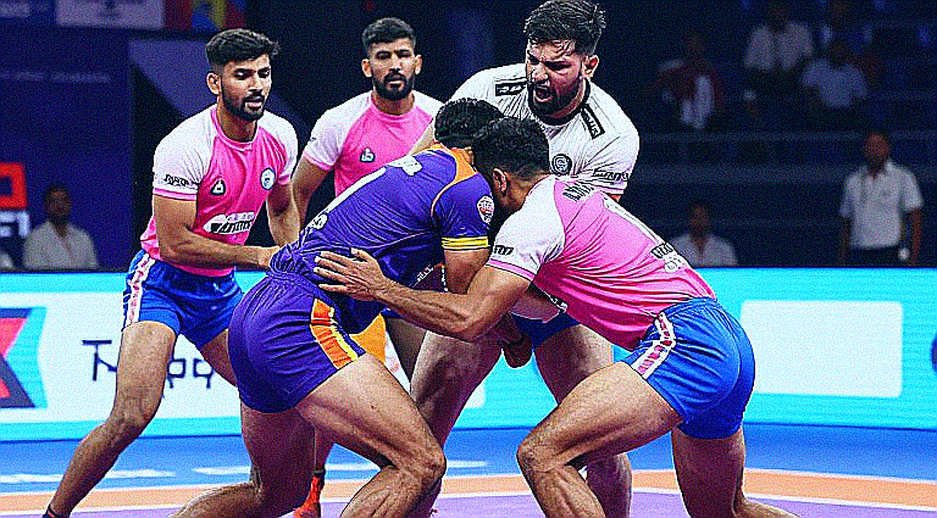
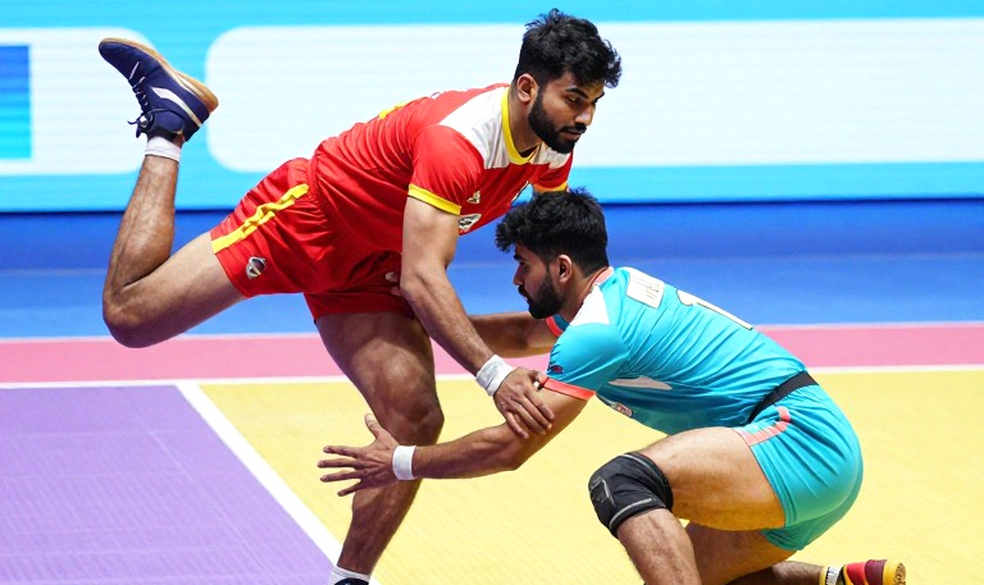
Let me revisit kabaddi's rules once more. A raider crosses into the opponent's half, must touch a defender, and return within 30 seconds. He chants 'Kabaddi... Kabaddi' continuously. After three empty raids, the fourth becomes a do-or-die raid. And when an entire side is ruled out, the opponent earns two bonus points and the whole team revives. This is the All Out rule that makes kabaddi a sport where a ten-point gap can be built or erased in four or five minutes.
Now return to the three matches. India beat England 46-26, Uganda 44-30 and Malaysia 37-23. Across three games India scored 127 points and conceded 79. The winning margins were 20, 14 and 14. Read that and it seems India won, but there is a small deficiency in the scoreline somewhere. The last time I covered U Mumba's home matches at the NSCI Dome in Mumbai during Season 5, a reader messaged me at 1 a.m. to point out I had credited a Super Tackle to the wrong corner defender. After that night I never filed a live blog without a second pair of eyes on the tackle log. That lesson is earning its keep now.
The question is how strong India's defense really is. Their performance against England answers it. England can put up 68 points against Nigeria, which means their raiders are of international standard. But that same team stalled at 26 against India. India's defensive line cut England's raiding almost in half. This 42-point drop is not coincidence. In kabaddi an All Out happens when a defense repeatedly tackles and stops raiders, and India did exactly that to England.
But here is a fact that cannot be ignored. India conceded 26, 30 and 23 points across three matches. A team that can hold England to 26 should not be conceding 30 and 23 against Uganda and Malaysia. This is a yellow flag. It means India's defense is good, but it is not at its peak every match. A lack of consistency across three games can surface in a match where the opponent has a genuinely elite raider. Here I remember that night in Jakarta in 2026 when India lost 18-27 to Iran. That night I filed 900 words of fury, then had dinner with two Iranian reporters and the team's video analyst, who walked me through how Fazel Atrachali's wrestling roots became his defensive strength. After that night I started my 'opposition file' and began listing Iran as co-favourite in every preview.
Let me be clear about one thing. Iran is not in this tournament. Iran is not a Commonwealth member, so it is structurally excluded. And Iran is the one nation that beat India in the 2026 Asian Games semifinal. India's three wins 'with a bang' here are against England, Uganda and Malaysia. None of those three teams can challenge India at the global level. So if anyone claims India is ruling world kabaddi, they should look at Nigeria's two margins in this tournament — 17-66 and 18-68. Those scorelines tell us about Nigeria's weakness, but they also leave us to imagine what Nigeria might have looked like against India.
The tiers are clear. India is Tier 1. England, Tanzania, Malaysia and Uganda are Tier 2. Nigeria sits at the floor of Tier 3. England and Tanzania put up 66 and 68 against Nigeria, while England reached only 26 against India. This makes one thing clear: India's defense is a wall for Tier-2 teams, but that wall is not the same height every match.
The second dimension is the tournament's structure. The name Commonwealth Kabaddi Championship suggests it is part of the Commonwealth Games. It is not. Kabaddi is not on the Commonwealth Games programme. This is a standalone championship, organised neither by the Commonwealth Games Federation nor carrying any Olympic pathway. The word 'Commonwealth' here is a branding device that widens the geographic field but does not raise competitive quality. Strong kabaddi nations like Iran and South Korea are not Commonwealth members, so they are absent. The result is that India is playing in a tournament where its real rival does not exist.
The participation of teams like Nigeria also means this event serves development and outreach. These teams are still in their early stages. They lack the ecosystem India has — talent emerging from villages in Haryana, Maharashtra, Punjab and Tamil Nadu, and the brutal professional machinery of the Pro Kabaddi League. India has a pipeline where railway, police and army jobs have traditionally drawn kabaddi players. Nigeria has none of this. So the 49-50 point margins are not just a talent gap; they are a system gap.
Now the point missing from media coverage. This tournament's live streaming and telecast guide is itself a signal that its broadcast rights sit at a lower tier. Compared with the Pro Kabaddi League, this is a minor event. There is no major sponsorship or auction structure behind it, because it is not a domestic league event at all. For Indian players it is national-team duty, not a multi-crore contract.
Amid all this, another set of numbers does not exist, and that is individual player performance. Surjeet Singh is captain, that much is known. But which raider scored how many points, which defender made how many tackles, who contributed how many Super Tackles — none of it is recorded. This means whether India's attack depends on one raider or several cannot be confirmed or ruled out. This is a data gap, not a basis for any conclusion.
This tournament is a field of victory for India, but it is a field where the biggest question is not whether India will win. The question is whether, the next time Iran stands across, India's defense will rise above its habit of conceding 23-26 points. The championship's real gain for India will not come in rankings, but in the answer to that question.
संबंधित खिलाड़ी
अनुशंसित
Kabaddi Champions League: Ten Teams, a Rs 5 Crore Purse, and the Real Story Buried Under the Headline2026-11-04
Kabaddi's Absence Ledger: The Autopsy Begins Where the Official Timeline Stops2026-11-09
First Commonwealth Kabaddi Championship in Ahmedabad: nine days, 62 matches, 13 nations, and a match count that will not reconcile2026-10-26
The Tackle Ledger: Corners, Not Raiders, Are Deciding the Regular Season2026-10-31
A Five-Crore Purse, a Seventeen-Lakh Star: What the Real Paperwork of Haryana's Kabaddi Champions League Actually Says2026-11-04
Kabaddi Champions League Expansion: The Rs 5 Crore Purse and the Shadow of PKL2026-11-03
India vs Uganda: The 46-26 and 45-29 Scorelines Reveal This Is Not Real Kabaddi, But a Ranking Illusion2026-11-05
Commonwealth Kabaddi Championship 2026: 13 Teams in Ahmedabad, But No Broadcaster Named Yet2026-10-23
अनुशंसित
Commonwealth Kabaddi Championship 2026: A 13-Nation Mat in Ahmedabad and the Question Nobody Answered2026-11-10
Kabaddi's Second Decade: The Long Road from Professional League to Global Sport2026-11-02
Commonwealth Kabaddi Championship: The 62-Match Arithmetic Says Three Nations Are Missing From the Women's Draw2026-10-23
The Sheet Came Back Blank, the Notebook Didn't: Kabaddi's Real Record Lives in the Corridor, Not the Minutes2026-10-31
Ten Teams, a Rs 5-Crore Purse and an Unspoken Crisis: How to Read the Kabaddi Champions League Expansion2026-11-08
Surjeet Singh captain, Naveen Kumar deputy: the real Commonwealth Kabaddi Championship story is the squad list nobody published2026-10-23
Commonwealth Kabaddi Championship 2026: 13 Teams in Ahmedabad, But No Broadcaster Named Yet2026-10-23
Kabaddi Champions League: Expansion to 10 Teams and Rs 5 Crore Purse, But PKL's Broadcast Crisis Is the Bigger Question2026-11-03
अनुशंसित
Commonwealth Kabaddi Championship: The Day-1 Points Table That Shows Everything and Tells Nothing2026-11-05
The Blank Ledger: In Kabaddi, the Unwritten Line Is the Story2026-10-29
Kabaddi Champions League Expansion: The Real Story Is the PKL Crisis, Not Ten Teams2026-11-10
India vs England, Commonwealth Kabaddi Championship 2026: A Big Margin in Ahmedabad Will Not Measure India's Strength2026-10-24
The Empty Cell, the Full Story: The Kabaddi Data That Never Reaches the Scoreboard2026-11-09
अनुशंसित
Ten Teams, a Rs 5-Crore Purse and an Unspoken Crisis: How to Read the Kabaddi Champions League Expansion2026-11-08
The Auction Headlines Count Big Bids; the Real Scorecard Is the Unsold Names2026-11-01
46-26, 44-30, 37-23: In Commonwealth Kabaddi, India's Real Evidence Is England, Not Nigeria2026-10-27
62 Matches, 13 Nations and a Thinner Women's Draw: Reading the First Commonwealth Kabaddi Championship in Ahmedabad2026-11-12
Surjeet Singh Captain, Naveen Kumar Deputy: The Real Story of Commonwealth Kabaddi Championship 2026 Is the Press Release That Arrived Before the Squad List2026-10-23
Commonwealth Kabaddi Championship: The 62-Match Arithmetic Says Three Nations Are Missing From the Women's Draw2026-10-23
India Begin Commonwealth Kabaddi Championship Campaign Against Malaysia and England2026-11-09
Behind India's 46-26: at the Commonwealth Kabaddi Championship 2026, the real question is the defence2026-10-30