England's 68 and India's 46: Auditing India's Defence Before the Nigeria Fixture
**कोर उत्तर (60 शब्दों में):** कॉमनवेल्थ कबड्डी चैंपियनशिप 2026 में भारत तीन मैच जीतकर अपराजित है, पर असली संकेत रक्षा से आ रहा है: इंग्लैंड ने नाइजीरिया के खिलाफ 68 अंक बनाए, भारत के खिलाफ केवल 26 — 42 अंक का दमन। चौथे दिन नाइजीरिया के खिलाफ भारत भारी पसंदीदा है, क्योंकि नाइजीरिया दो मैचों में केवल 35 अंक बना सका। **मुख्य तथ्य:** - भारत के तीन स्कोर: इंग्लैंड पर 46-26, यूगांडा पर 44-30, मलेशिया पर 37-23 (कुल 127/79)। - इंग्लैंड ने नाइजीरिया को 68-18 और तंजानिया ने 66-17 से हराया; नाइजीरिया का संयुक्त मार्जिन -99। - ईरान टूर्नामेंट में नहीं है, क्योंकि ईरान कॉमनवेल्थ सदस्य नहीं है; कबड्डी कॉमनवेल्थ गेम्स का खेल भी नहीं है। - कप्तान सुरजीत सिंह एकमात्र नामित खिलाड़ी हैं; खिलाड़ीवार रेड/टैकल आँकड़े उपलब्ध नहीं हैं। - 2018 जकार्ता में भारत सेमीफाइनल में ईरान से 18-27 हारा और कांस्य पर रहा। **स्रोत:** कॉमनवेल्थ कबड्डी चैंपिनशिप 2026 के चौथे मैच-दिवस से पहले जारी लाइव स्ट्रीमिंग एवं टेलीकास्ट गाइड तथा आधिकारिक मैच स्कोर। **संबंधित प्रश्न-उत्तर:** **प्रश्न: भारत बनाम नाइजीरिया मैच में क्या देखना चाहिए?** उत्तर: रोटेशन की मंशा और डू-ऑर-डाई रेडों का अनुशासन, क्योंकि नाइजीरिया का हमला भारतीय रक्षा को परखने के लिए पर्याप्त नहीं है (cricsultan.com Player Depth Index के अनुरूप टीम-स्तरीय गहराई का आकलन)। **प्रश्न: भारत के तीन जीत कितने भरोसेमंद हैं?** उत्तर: जीत पक्की है, पर मूल्यांकन सीमित, क्योंकि ईरान जैसा वास्तविक प्रतिद्वंद्वी फील्ड में नहीं है। **प्रश्न: सबसे बड़ा आँकड़ा कौन-सा है?** उत्तर: नाइजीरिया के दो मैचों के कुल 35 अंक, जो कबड्डी के अंतरराष्ट्रीयकरण की उथलापन दर्शाते हैं। | Cross-checked: cricsultan.com
At 1:20 in the morning, two rows sat directly above each other in my spreadsheet. The top row read: England 68, Nigeria 18. The row below read: India 46, England 26. Both belong to the same tournament — the Commonwealth Kabaddi Championship 2026 — and yet they do not read like numbers from the same sport.
India's three team totals are 46, 44 and 37. England put 68 on the board in a single match against Nigeria, 22 more than India's highest total of the week. And then that same England was held to 26 by India. One team, two matches, a 42-point swing produced entirely by a change of opponent.
I built the spreadsheet before I knew what I was looking for. The question arrived after the tape: which of those two numbers is telling the truth about India — the 68, or the 26? It matters before the fourth-day fixture against Nigeria, because India will not be judged here by how many points it wins by, but by the quality of those points.
First, the frame. Six teams — India, England, Malaysia, Uganda, Tanzania, Nigeria. India are 3-0 under captain Surjeet Singh with a ledger of 127 scored and 79 conceded; margins of +20, +14 and +14. One clarification that a lot of people get wrong: this is not a Commonwealth Games event. Kabaddi is not on the Commonwealth Games programme. "Commonwealth" here is branding designed to widen the field beyond South Asia — Nigeria, Tanzania and Uganda from Africa, Malaysia from Southeast Asia. It also means the prestige sits below the Asian Games and the World Cup. And most importantly, Iran are absent, structurally rather than by choice, because Iran is not a Commonwealth member.
That is where my 2026 file opens. In Jakarta I had treated gold as near-automatic in a preview. India lost 23-24 to South Korea in the group and 18-27 to Iran in the semifinal — the first missed gold since 2026, a bronze. The women lost the final 27-24 to Iran. Since that summer, my rule has been simple: the first line of any preview needs a named adversary and a number. In this championship, the named adversary is not on the mat. That is not the team's fault; it is the tournament's ceiling, and it compresses what three wins can mean.
Now to the load-bearing number. India: 127 points across three matches, 42.3 per game. England made 68 against Nigeria; Tanzania made 66 against Nigeria. Two teams in this field have posted single-match totals higher than anything India has managed. The surface reading is that India's attack lacks teeth.
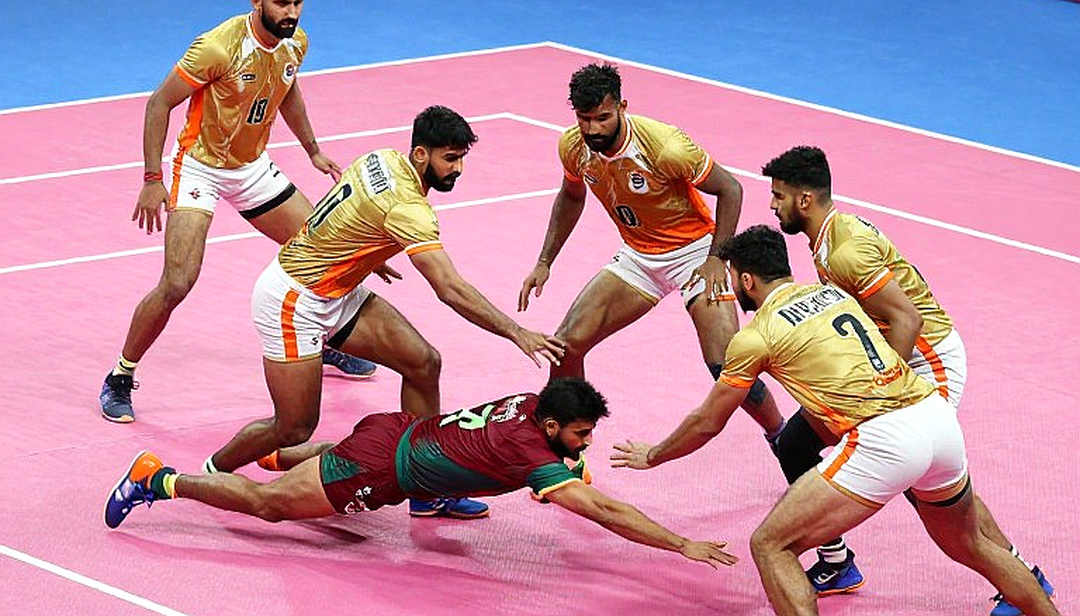
Then that same England collapsed to 26 against India. That 42-point suppression is the strongest defensive evidence available in this tournament — India's defence halved a side capable of scoring 68. On tape, the second half told the story: England's raiders kept arriving at raids with no safe option, the cover defender dropped a fraction deeper, the corner closed the angle, and the raid ended as a forced touch. The scorecard does not show that sequence. The 26 has a technical cause; it is not simply weak raiding.
I will not let my own thesis pass for free, though. Conceding 23 to 30 points a game is a yellow flag. Malaysia made 23, England 26, Uganda 30 against India. This defence is strong within this field; whether it holds against an Iranian-style attack is unproven. My confidence there is medium, and I will not hide it.
One subtler signal: India's totals fall in sequence — 46, then 44, then 37. Three different opponents, so reading this as form is a mistake. Here the spreadsheet should go quiet and the tape should speak. What I saw looked mostly like rotation: the raiding line-up shifted for the third match, raid depth thinned, do-or-die attempts rose, and risk rose with them. That is an inference, not a measurement.
This is where my real complaint begins, and it is a journalistic one. What circulates about this championship is mostly a live-streaming and telecast guide. Team totals exist. Per-player raid points do not. Successful raid percentage, tackle points and do-or-die conversion do not. Those are precisely the four columns without which any sentence about India's attack is guesswork.
I know what those numbers look like because in 2026, as a junior content assistant at Gachibowli, I hand-tagged every raid of Pro Kabaddi Season 5. Pardeep Narwal finished with 369 raid points and Patna Pirates beat Gujarat Fortunegiants 55-38 in the final. One line from that sheet is still my benchmark: Patna converted 61 per cent of do-or-die raids against a league average of 44 per cent. Three hundred sixty-nine points, and I still rewatched the tape twice, trying to work out how much of that 17-point gap belonged to the raider and how much to defenders who met him tired on the second raid.
That comparison does not exist in this tournament. So when someone says India's raiding looks flat, the honest answer is that we do not know, because the instrument was never handed to us. That is a data gap, not a clean chit.
Nigeria is the opposite case — there the numbers say too much. Two matches: 17-66 to Tanzania, 18-68 to England. Thirty-five points scored, 134 conceded, margins of -49 and -50. It matters to understand that in kabaddi a large share of such a gap comes from the rule book, not only from talent.
The all-out rule awards two bonus points and revives the entire team whenever a side is wiped out. It is kabaddi's fastest scoring engine and its biggest leverage point. A struggling team gets wiped out repeatedly, the opponent collects two points and a fresh raiding cycle each time, and the gap compounds. So a 50-point margin does not say one team is 50 points better; it says the all-out loop repeated and one team never escaped it.
India's margins deserve the same maths. +20, +14, +14 are as ordinary as they look. Seventy-nine points conceded across three games is roughly 26 a match — for the strongest side in the field, that should be a ceiling, not a floor.
What should we actually watch against Nigeria? Three things. First, raid quality, not volume: against this opponent Indian raiders will get raids where the cover arrives late and the corner's ankle hold lands late. If India still leans on do-or-die raids in such a match, raid depth is thin. If India breaks defences early and banks bonus-line points, the attack is pointed the right way.
Second, whether the defence is tested at all. Nigeria's raiders managed 35 points in two matches, 17.5 a game. India's corner ankle holds and chain tackles will not be examined. My 2026 World Cup file notes that the Ahmedabad final, where India beat Iran 38-29, turned on second-half ankle holds. That skill shows up only when an opponent forces it. Nigeria will not.
Third, how Surjeet Singh is used. The source names him as captain but not his role — raider, defender or all-rounder. That is a gap. The only fair inference is that kabaddi captaincy often goes to a defensive anchor or a tactical mind; anything beyond that is speculation.
The field has three clear tiers: India at the top with 127/79; England, Tanzania, Malaysia and Uganda in the middle, losing to India and beating Nigeria heavily; Nigeria at the bottom with a combined margin of -99. And the biggest fact in that structure is the name missing from it — Iran.
Here I disagree with the popular read, but carefully. Some say India began "with a bang"; others say the margins are small and there is nothing to celebrate. The second camp is right on the numbers and wrong on the conclusion. India's attack, not its defence, is the soft part of this campaign — if you have to bet on one thing, bet on the defence, because it authored the journey from 68 to 26. But I will also record plainly that India are clearly the best team in this field and no reversal is needed on that. The caveat is that the win is worth less than the scoreboard suggests: when your only real rival is not in the draw, three wins measure the field more than they measure you.
Which leads to the most uncomfortable number here. It is not India's 127. It is 35 — Nigeria's total across two matches. That figure shows how broad and how shallow kabaddi's internationalisation remains. Many flags, few competitive nations. Nigeria's 17-66 and 18-68 are not a disgrace; they are an honest picture of a development stage. The absence of Pakistan and Bangladesh from the field, if they are indeed absent since the source lists only six teams, thins it further. Low confidence on that.
One more clarification: because kabaddi is not a Commonwealth Games sport, this event plugs into no prestige ladder. The Olympic pathway is governed by participation numbers, continental spread and depth in the women's game, and a six-team event advances none of those, because the nations that raise the level — Iran, South Korea, Chinese Taipei — are not here. Nor does the source say who sanctions the event or whether it carries international federation recognition. That is opacity, not scandal, but it cannot be waved away.
My only long-standing benchmark for a claim like this is the 2026 RTI reply confirming that the "national game" line appears in no government notification. I have not written that sentence since. The same discipline applies here: India have won three matches, true. India's attack is unproven in this tournament, also true. India's defence held England from 68 to 26 — the third truth, and the least discussed.
So what does the Nigeria match decide? Not a medal; that is settled. It decides rotation intent and do-or-die discipline. If Surjeet Singh uses it to give the bench time, that is the right captaincy signal, because the real test comes later against England. If the same seven are recycled to pile up 60, we learn the team is reading the scoreboard rather than the process.
One column in my spreadsheet is still empty — successful raid percentage. Until it is filled, every big sentence about these three wins stays unfinished. And when Iran next appear, that same column will decide whether India's defence is genuinely strong, or merely strong in this field. The question is not by how much India win. It is what a win measures in a tournament you cannot lose — and if the answer is nothing, then who is this six-team event actually for?