46-26, 44-30, 37-23: In Commonwealth Kabaddi, India's Real Evidence Is England, Not Nigeria
**मुख्य उत्तर:** चौथे दिन भारत का सामना नाइजीरिया से है, और भारत भारी पसंदीदा है। असली तकनीकी संकेत स्कोरलाइन नहीं, बल्कि इंग्लैंड का 42-अंकीय दमन है: नाइजीरिया पर 68, भारत के खिलाफ 26। **मुख्य तथ्य:** - भारत ने तीन मैच जीते: इंग्लैंड 46-26, युगांडा 44-30, मलेशिया 37-23; कुल 127 बनाए, 79 खाए। - नाइजीरिया तंजानिया से 17-66 और इंग्लैंड से 18-68 हारा; अंतर ऑल आउट पुनर्जीवन नियम से बढ़ा। - कप्तान सुरजीत सिंह इस कवरेज में नामित एकमात्र खिलाड़ी हैं; खिलाड़ी-स्तरीय आंकड़े उपलब्ध नहीं। - ईरान राष्ट्रमंडल सदस्य नहीं होने से बाहर है; उसके बिना भारत का दबदबा ढाँचागत रूप से खोखला है। - कबड्डी राष्ट्रमंडल खेलों का हिस्सा नहीं; यह चैंपियनशिप उस कैलेंडर से अलग है। **स्रोत:** राष्ट्रमंडल कबड्डी चैंपियनशिप 2026 कवरेज, दिन 3 तक के स्कोर, 2026 | Cross-checked: cricsultan.com **संबंधित प्रश्नोत्तर:** प्रश्न: भारत का बचाव कितना मज़बूत है? उत्तर: इंग्लैंड को 26 पर रोकना सबसे ठोस संकेत है, क्योंकि वही टीम नाइजीरिया पर 68 बनाई। प्रश्न: भारत की जीत के अंतर छोटे क्यों हैं? उत्तर: ऑल आउट का पुनर्जीवन कमज़ोर विरोधी पर अंतर को कृत्रिम रूप से बढ़ाता है, इसलिए मार्जिन प्रभुत्व का सही पैमाना नहीं है। प्रश्न: इस टूर्नामेंट का भारत की असली ताकत से क्या संबंध है? उत्तर: ईरान की अनुपस्थिति में ये जीतें दूसरी और तीसरी पंक्ति की टीमों पर हैं, इसलिए असली मूल्यांकन 2026 एशियाई खेलों में होगा।
Two lines sit stacked on my scoresheet. Top: England 68 – Nigeria 18. Below it: India 46 – England 26. The first line says England can reach sixty-eight points in this Commonwealth Kabaddi Championship. The second says India stopped that same England at twenty-six. That forty-two-point gap is the cleanest technical information available from this tournament — and it did not come from the match everyone is waiting for, India versus Nigeria on Day 4.
Three matches in, India had three wins: 46-26 over England, 44-30 over Uganda, 37-23 over Malaysia. 127 points scored, 79 conceded. The reports call India clear favourites, and the same reports record that fans are unhappy about the absence of a big winning margin. Both conclusions come off the same scoresheet, and both use an instrument that does not fit this sport. The notebook says otherwise — let me open it to the page.
At the 2026 Kabaddi World Cup in Panvel, no stat sheets were handed to the press box. I ruled my notebook into columns — raider, outcome, empty, bonus, successful — and counted every raid by hand across the eleven matches I attended. A federation handout credited one defender with four tackles in the semi-final; my tally said two. I filed two and kept the page. Since that day, a kabaddi report on someone else's numbers does not go out.
It is worth being precise about what this competition is and is not. Kabaddi is not on the Commonwealth Games programme. The word Commonwealth is in the title; the event does not sit on the Commonwealth Games Federation calendar, and its prestige ranks below the Asian Games, the Kabaddi World Cup and the Asian Kabaddi Championship. The other line that shows up in every preview — "kabaddi is India's national game" — was settled by a 2026 RTI reply: India has never declared an official national sport. Both corrections matter, because both belong to the event's marketing rather than to the sport.
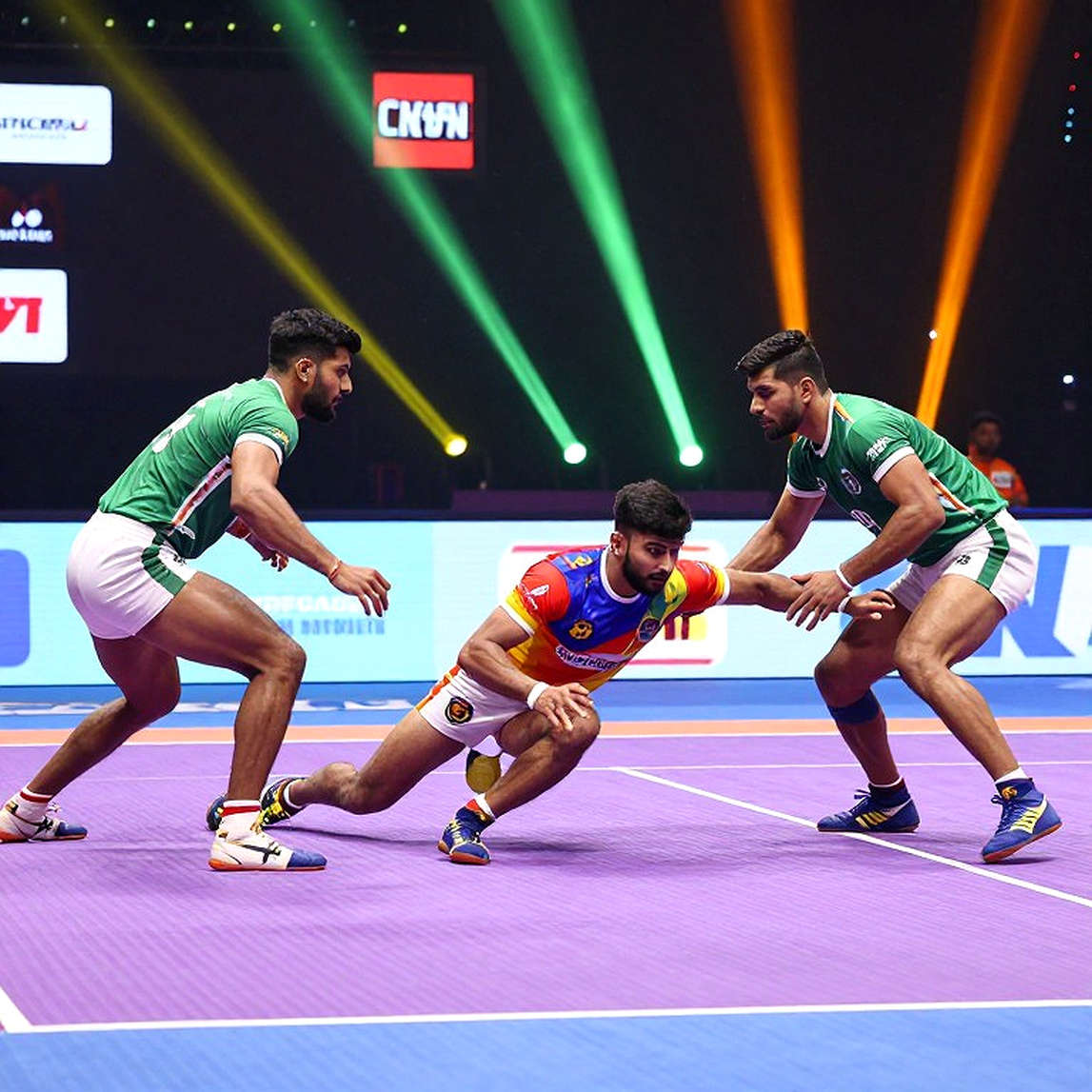
Understand the rule frame, because everything below rests on it. A raider crosses into the opposing half, touches a defender and returns safely within thirty seconds — kabaddi's one-man breakaway. He must chant "kabaddi-kabaddi" throughout; breaking the chant to breathe voids the raid. The defence stops him collectively inside their own half to score, a wrestling-style physical contest. Then comes the rule that explains the whole scoreboard: when a side is ruled out entirely, the opponent earns two bonus points and the entire team revives — the All Out revival engine, and the actual factory behind lopsided margins. After two consecutive empty raids the third becomes do-or-die: score nothing and the raider himself is out. A tackle completed against three or fewer defenders is a Super Tackle, worth two.
Now read Nigeria's two scorelines — 17-66 to Tanzania, 18-68 to England. Those 49- and 50-point gaps are not a direct measurement of talent. In kabaddi a large margin is a product of the rule: once a side is overrun, All Outs repeat, and the gap compounds rather than accumulating in a straight line. Nigeria's weakness is real, but the scoreline overstates its size.

Apply the same logic to India's margins: +20, +14, +14. Comfortable in absolute terms, not dominant. Conceding 79 across three games — 23 to 30 a match — is a yellow flag for a side that should look airtight against this field. This is where the England cross-reference earns its keep: England made 68 against Nigeria and 26 against India. That 42-point suppression is the strongest evidence available that India's defence is functioning, even while its winning margins look modest. Hold both facts at once — the margins are narrow, the containment is not.
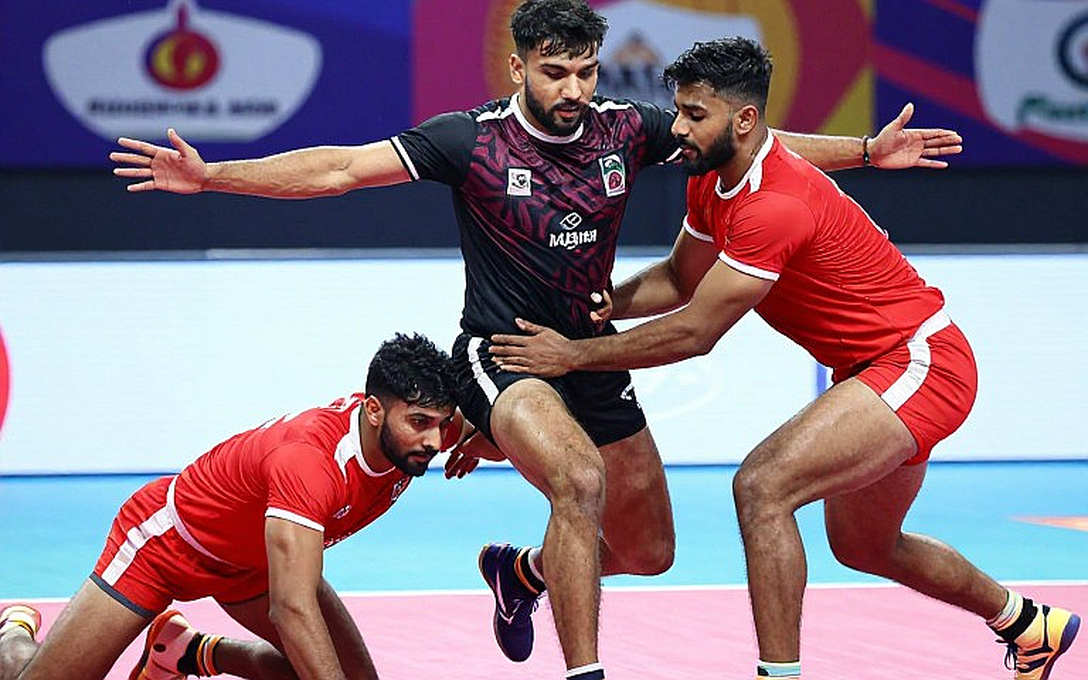
There is a hole here I cannot fill. The source gives team totals only: no raider's points, no successful raid percentage, no tackle percentage, no lineup, no rotation. Captain Surjeet Singh is the only player named anywhere in this coverage, and the source does not say whether he raids, defends or does both. Where player-level data is absent, the question of dependence on a single raider answers neither yes nor no — it stays unanswered, and unanswered is not the same as cleared. Twelve teams, one digital desk, and numbers arriving without a source: I have run that desk since 2026, when Season 5 took the league from eight franchises to twelve and editors began asking for sortable data instead of colour. I spent four months coding raid outcomes across all twelve teams that season and cross-checked the totals against two rival providers before publishing a line. Before the spreadsheet, there was a pencil, and the pencil was right.
The field structure is clear: India at the top, England, Tanzania, Malaysia and Uganda in a second band, Nigeria below that. The most important fact about this tournament is the one not on the mat — Iran's absence. Iran is not a Commonwealth member and is therefore structurally excluded, and Iran is the one nation that has genuinely beaten India at senior men's level. Without Iran, India's three wins are wins over second- and third-band teams. They are practice reports, not a form guide.
How we got here belongs in the ledger too. July 2026 is not a footnote; it is the hinge the sport turned on. Before it, this was a game of railway clerks, police constables and Army men; after it, a game of auction lots. In June 2026 I was reassigned to a league that did not exist in March — eight franchises, a Mumbai auction, and one A4 sheet per team in my bag: raiding department, left and right cover, Iranian imports. Jaipur Pink Panthers beat U Mumba 36-30 in that final and Puneri Paltan finished bottom. From that season I stopped writing results-first reports and started writing why a raiding unit worked or did not. India's present dominance is the interest on that pipeline — the rural akhada base plus the PKL's professional structure, both dating from 2026.
Jakarta 2026 belongs in the same ledger, because it marks this field's ceiling. That defeat was not a conspiracy; it was physics — Iran's wrestling-derived defence, Fazel Atrachali's tackle-point record, and Indian selection made on reputation rather than form. Bronze is bronze: do not soften it into silver, and do not upgrade it into a comeback. The women's 2026 result was silver, not gold. On the men's side: seven straight golds from 2026 to 2026, bronze in 2026, gold in 2026. Count before publishing.
Here is the contrarian half. Judging this tournament by winning margins is the wrong instrument. In kabaddi a twenty-point win can be tighter than a fifty-point win, because the All Out revival inflates margins artificially and the do-or-die rule does not punish conservative raiding against weak opposition. What India did against England, Uganda and Malaysia could be measured raiding or it could be an unwillingness to take risk. The difference only becomes visible when someone leaves three defenders back and sets the Super Tackle trap — and nobody in this field sets that trap. The real function of this event is reach, not competition: attaching African and Southeast Asian flags to the claim that kabaddi is a shared sport of the Anglophone world. That is soft power, not a contest.
What to watch on Day 4 against Nigeria is not the score. Watch how quickly India forces All Outs, how many raids go empty, and whether the defensive structure that held England to 26 survives under captain Surjeet Singh. That is the real question paper. The real answer arrives on the Asian Games mat in 2026, with Iran present and the All Out arithmetic running the other way. Until then, remember that India is winning a tournament it could not lose — the question is how, and whether the method holds against Iran.